 |
 |
|
|
|
|
|
 |
|
 |
Running
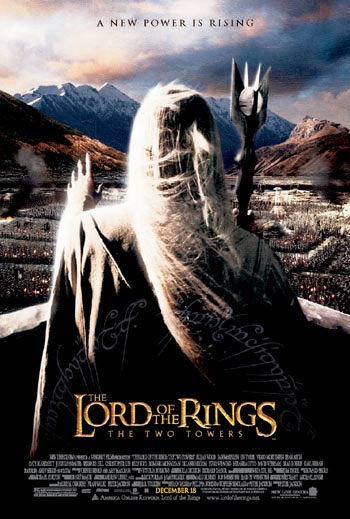
time: 179 minutes by Kevin Lang I didn't mind the lack of story development. Sometimes stories are better off slowing down to let the audience thoroughly enjoy what has already been established (similar in some ways to The Empire Strikes Back). If this had been the only film in the trilogy, then I would have wanted much more from the story, but knowing that there are two more films flanking The Two Towers, I didn't mind that this one focused primarily on the ensuing battle at the end, as Saruman's forces began their attempt to eradicate man from the earth. In The Fellowship of the Ring, it was hard to find characters to get behind and root for, and at the end of the film I felt as if a greater impact could have been made upon the audience if they had characters to allege themselves with. Sure, there was Frodo (Elijah Wood) and Sam (Sean Astin), but Aragorn (Viggo Mortensen), who had both great physical and mental strength, we were uncertain about. In this film unlike the first, Aragorn is well beyond the Ring's grasp. He has chosen his path, and has become a clear-cut hero who we can stand behind. If the theme behind J.R.R. Tolkien's Lord of the Rings trilogy wasn't made clear enough in the first film, it became extremely evident here. Like in most stories, the battle and conflict in The Two Towers is one between good and evil. In this film the characters are clearly on one side or the other (except for the CGI Gollum). This made the final battle that much more powerful. It erupted on a biblical scale. The combination of live action sequences, visual effects, sound, and set design were flawlessly woven together to create a massive stand to stop the destruction of goodness and to prevent the domination of evil. Perhaps the biggest risk that the film took was to include the CGI character, Gollum, who Frodo and Sam used to guide them through Mordor. In the end I think the risk paid off, but I do feel that Gollum's presence as a CGI character didn't greatly add much to the film. He was visually impressive and much more appealing than Jar Jar Binks, but in the end his significance in the film came more on a filmmaking scale rather than a storyline scale, as if the filmmakers were trying to say, "look what we can do," rather than, "look what we've created for the story." Overall, moviegoers
who didn't quite get what all the raving was about after seeing The
Fellowship of the Ring, may in fact change their points of view after
watching The Lord of the Rings: The Two Towers. They may also come
to understand the story's deeper meaning. Even the trees came together
to help protect the goodness of the earth, led by the CGI character Treebeard.
What's more amazing is that The Two Towers pulls all of these characters
off, not to mention its most convincing element, the final battle, which
successfully depicted an army of Saruman's forces in excess of 10,000
soldiers. This final battle helped to create a more complete film than
the first. In the end, I felt more satisfied, while still eagerly anticipating
the trilogy's final chapter. "The Lord of the Rings: The Two Towers" Review written December 16, 2002, CTF.
|
|
||||
REPLY
TO THE WRITER |
BOARDS | HOME
| PRIVACY
POLICY
ChasingtheFrog.com,
CTF Media
 3/4
out
of
3/4
out
of  Stars, Movie Grade: A+