|
"Seabiscuit
did just what I'd thought he'd do. He made a rear admiral
out of War Admiral." - Red Pollard, 1939 (after
learning of Seabiscuit and George Woolf's victory against
War Admiral)
Questioning the Story:

Was jockey Red Pollard born in the United States as the
movie implied?
No, as stated above Red Pollard was born in Edmonton, Alberta.
His family did fall upon hard times, but not because of
the depression. They lost their brick factory business as
the result of a flood. Their insurance didn't cover enough
of the damages. A friend of the family was coming to the
U.S. and brought Red Pollard with him.
Did Red's parents really leave him behind at a racetrack?
No, the friend of Red's family who brought Red to the
U.S. abandoned him at a racetrack in Montana.
Did
Seabiscuit owner Charles Howard really run a bicycle shop
before making a fortune in the automobile industry?
Yes,
this is true. Prior to opening the bicycle shop, Charles
Howard had been a Calvary officer but got sick. He left
the army, and moved from New York to San Francisco. He actually
arrived in San Francisco in 1903, before the earthquake,
which is somewhat earlier than the movie depicts.
Did Charles Howard only have one son?
No, Charles Howard also had two older sons. It was the youngest
of the three, Frankie, who died in an automobile accident.
Frank
was actually around fifteen when he died, not twelve as
the movie implies. This change was likely made to enhance
the innocence of the character and to make Howard's grief
seem more heart-wrenching onscreen. In real life Howard
would later build a hospital close to the location where
Frankie died. He named the hospital after his son.
How did Charles Howard really meet his second wife Marcela?
Marcela was the older sister of Charles Howard's son's wife.
What
methods did jockeys use to lose weight?
Jockeys used several different methods for losing weight.
Some put on rubber suits and buried themselves in manure
for extended periods of time. Others chose even more extreme
methods such as swallowing the eggs of a tapeworm. The worm
that hatched inside them would eat away at the food that
they consumed. However, it would also consume the food's
nutrients as well, often leaving the jockeys malnourished
and with brittle bones.
Seabiscuit was a direct descendant (grandson) of the
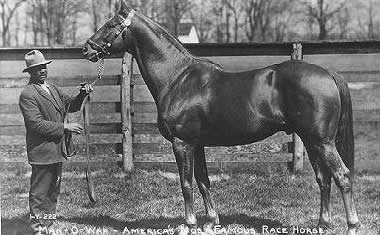
legendary horse Man O'War. Who exactly was Man O'War?
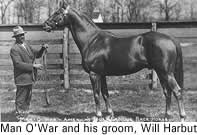 The
great Man O'War was a legendary racehorse born March 29,
1917. His lifetime record was 21 starts with 20 wins (in
one race he took second place). He broke records by several
seconds, including 3 world records, 3 American records,
and 3 track records. At times, he carried as much as 138
pounds, and after 3 years of racing his owner decided to
retire him from the track, fearing that he would injure
himself under such significant weight. Man O'War died on
November 11, 1947 with close to 2000 people attending his
funeral. He was the father of Seabiscuit's rival, War Admiral.
Man O'War's sire line still exists today in horses such
as Relaunch. -About.com The
great Man O'War was a legendary racehorse born March 29,
1917. His lifetime record was 21 starts with 20 wins (in
one race he took second place). He broke records by several
seconds, including 3 world records, 3 American records,
and 3 track records. At times, he carried as much as 138
pounds, and after 3 years of racing his owner decided to
retire him from the track, fearing that he would injure
himself under such significant weight. Man O'War died on
November 11, 1947 with close to 2000 people attending his
funeral. He was the father of Seabiscuit's rival, War Admiral.
Man O'War's sire line still exists today in horses such
as Relaunch. -About.com
Just how popular was Seabiscuit?
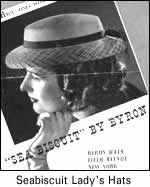 As
Seabiscuit-itis took hold of the country, Charles Howard
wasted no time in merchandising his horse. There were Seabiscuit
lady's hats (pictured left), board games, a pinball machine,
a line of oranges, dry cleaning services, and even Seabiscuit
hotels. In 1938, as a result of Howard's endless promoting
of his racehorse, Seabiscuit got more news ink than President
Franklin Roosevelt or Nazi leader Adolf Hitler. For his
final race on March 2, 1940 at Santa Anita, Seabiscuit drew
a crowd of 78,000 spectators, which is the equivalent to
a modern day Superbowl crowd. This was at a time however,
when the country had about half the population of today. As
Seabiscuit-itis took hold of the country, Charles Howard
wasted no time in merchandising his horse. There were Seabiscuit
lady's hats (pictured left), board games, a pinball machine,
a line of oranges, dry cleaning services, and even Seabiscuit
hotels. In 1938, as a result of Howard's endless promoting
of his racehorse, Seabiscuit got more news ink than President
Franklin Roosevelt or Nazi leader Adolf Hitler. For his
final race on March 2, 1940 at Santa Anita, Seabiscuit drew
a crowd of 78,000 spectators, which is the equivalent to
a modern day Superbowl crowd. This was at a time however,
when the country had about half the population of today.
Did Red Pollard have a wife?
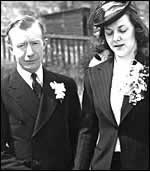 Yes,
in the spring of 1939 Red Pollard married his private duty
nurse, Agnes Conlon, who cared for him after he shattered
his leg. The two married at Charles Howard's ranch in Ridgewood,
California. The movie unfortunately omitted Agnes, who did
play a significant part in Pollard's recovery and return
to the track. It was actually Agnes who hung the medal of
Saint Christopher around Pollard's neck for good luck on
the day of Seabiscuit's last race, not Charles Howard's
wife. Agnes and Red had two children, a daughter born in
1940 and son born several years later. Yes,
in the spring of 1939 Red Pollard married his private duty
nurse, Agnes Conlon, who cared for him after he shattered
his leg. The two married at Charles Howard's ranch in Ridgewood,
California. The movie unfortunately omitted Agnes, who did
play a significant part in Pollard's recovery and return
to the track. It was actually Agnes who hung the medal of
Saint Christopher around Pollard's neck for good luck on
the day of Seabiscuit's last race, not Charles Howard's
wife. Agnes and Red had two children, a daughter born in
1940 and son born several years later.
How did Red Pollard later describe he and Seabiscuit's
enormous victory at Santa Anita in 1940?
Looking back prior to Seabiscuit's Santa Anita win, when
both he and Seabiscuit were too broken down and injured
to conceivably ever race again, Red remembered, "Seabiscuit
and I were a couple of old cripples together, all washed
up. But out there among the hooting owls, we both got sound
again." Red and Seabiscuit regained their strength
for their most victorious moment. Pollard would later say
of the March 2, 1940 Santa Anita win, "Don't think
that he (Seabiscuit) doesn't know he is the hero."
What was Seabiscuit's overall racing record and earnings?
Seabiscuit's overall racing record was 89 starts, 33 wins,
15 second place finishes, 13 thirds, and his total earnings
were $437,730.
What became of Seabiscuit and Red Pollard after the movie's
story ended?
Seabiscuit never raced again after his and Red's 1940 victory
at Santa Anita. He lived to be fourteen-years-old, rather
young for a horse since most live into their twenties. Red
Pollard never raced for Charles Howard again, but he did
race. Pollard tried to enlist in the army for WWII but was
turned down. He finally hung up his jockey gear and retired
from horse racing in 1955. He worked at the track post office
as a mail sorter, and also worked as a valet, cleaning the
boots of the riders. He eventually died of what was concluded
to be old age and a worn out body in 1981. Pollard's wife
Agnes, who had been sick with cancer, died two weeks later.
Watch the Full American Experience: Seabiscuit Documentary
Currently available in its entirety online, the episode chronicles the story of the real Seabiscuit and jockey Red Pollard. Narrated by Scott Glenn and released in 2003, the documentary offers historical footage of the legendary racehorse, it's owner and jockey, in addition to interviews, photos and commentary from those close to the story. Be patient as the PBS site video player window loads.
Watch Seabiscuit Race Video and Interviews:
Go behind the movie based on the book Seabiscuit: An American Legend by author Laura Hillenbrand and watch some of his most memorable races, including his legendary 1938 match race against War Admiral and his last race and victory before his retirement from the sport, which took place at Santa Anita in 1940.
|