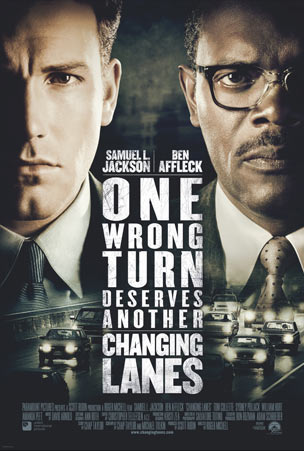
Changing
Lanes
Starring Ben
Affleck, Samuel L. Jackson
Directed by Roger Michell
Rated R
***1/4 out of 4 Stars

|
Changing
Lanes Directed by Roger Michell Rated R ***1/4 out of 4 Stars |
|
|
|
|
Released April 12, 2002 Running time: 99 minutes ***1/4 by Kevin Lang Director Roger Michell, who previously directed the top grossing British film of all time, "Notting Hill" (1999), may have been able to relate to this very idea. Three years ago he developed chest pains while traveling. He went to an emergency room and discovered that he was having a heart attack. That heart attack prevented him from directing one of last year's biggest box office disappointments, "Captain Corelli's Mandolin." In his time away from directing he rested and abandoned his desire to do another romantic comedy. Instead he chose to direct "Changing Lanes," a film that deals with the process of re-examining one's life, because of the effects set into motion by a single event. After his heart attack, Michell quit smoking, which likely came about as a result of a re-examination of his own lifestyle. On the surface of "Changing Lanes" there existed a feud between two men, Gavin Banek and Doyle Gibson (Ben Affeck and Samuel L. Jackson). Yet underneath there was a much deeper ethical battle that was occurring within each of them, and it was these two ethical struggles that deeply engaged my interest, and subsequently made the movie a much better film. The film put Gavin and Doyle face to face, not only with each other, but also with their daily lives. Doyle was an alcoholic trying to be a husband and a father, and Gavin was a knowing participant in a less than ethical law firm. A question soon confronted them. After fully realizing where they were at in their lives, both having been ethically and morally in the wrong, would each of them have the guts to do what was right, not only in their own lives, but between each other as well? I enjoyed watching Ben Affleck as the smug young lawyer Gavin Banek. He had previously brought this attitude, which is much his own, to other roles, but in none of his previous films did it work as well as in this one. Bringing out Affleck's talent as an actor was also likely due to Roger Michell's direction. After seeing Affleck's performance in this film, I finally feel that he may deserve to get the roles that he receives. I can almost picture him as the young Jack Ryan, who is the next character that he will portray in the upcoming film "The Sum of All Fears" (2002), based on the Tom Clancy novel of the same name. Let me remind you that I said that I could "almost picture him as Jack Ryan." He may be able to pull it off if he can embody the character as well as he did Gavin Banek, which would mean that he has finally fully arrived as an actor, solidifying his position among the Hollywood heavyweights. Samuel L. Jackson was convincing as Doyle Gibson. He effectively conveyed the nature of this conflicted man who struggled to provide his family with a husband and father that they could rely on. Jackson can play a wide range of roles as an actor, and it is again evident here. His acting seemed effortless at times, as if he truly was Doyle Gibson, which should be the goal of every actor, to convince us with doubtless certitude that his or her character is real. "Changing Lanes"
may not win any box office records, or garner any Academy Award nominations
(though we can't say for sure yet). However, it is film that took an idea
and shaped that idea into a surprisingly effective story. Screenwriter
Chap Taylor deserves to be commended for this. It is a film that takes
place over thirty-six hours, showing us that almost every action in our
lives is an evolving story, and the beginning and end of that story doesn't
have to be days, or even years apart. It can be just as effective, if
not more so, contained to a much shorter timeframe, which often magnifies
the intensity of what is happening. "Changing Lanes" is a film
that never wavered in its purpose. Being the perfected product of a finely
crafted screenplay, it kept me engaged from the beginning, and it left
me satisfied in the end.
Review written
April 13, 2002, CTF. |